Lordrush Viking Vengeance Strategy Guide
Interested in being a guide contributor? Let us know.
In your ongoing account progression of Lordrush, few events provide as much consistent value to building Governor Gear as Viking Vengeance. While Hero Gear is essential for individual squads, Governor Gear provides global stat bonuses to attack and defense that apply to every single march on your account simultaneously. To upgrade this gear, you require three primary resources: Satin, Gilded Threads, and the relatively scarce Artisan’s Visions.
Viking Vengeance is the premier bi-weekly alliance event designed specifically to farm these materials. However, most alliances fail to reach their full potential because they approach the event in an individualized way or without understanding the nuance of combat logic applied to Vikings Vengeance. This guide will dismantle common myths, explain the unique variations of the combat engine for Viking Vengeance, and provide a comprehensive blueprint for alliance-wide success to maximize your individual and alliance rankings.
Just need the essentials? The Viking Vengeance event page has the wave breakdown and rewards at a glance.
1. Event Fundamentals: 20 Waves of Invasion
Viking Vengeance is a cooperative alliance event that occurs every two weeks. Each active event brings two “invasions” in which players can participate. (You can participate in both for 2x the rewards!) Alliances have a 24-hour window on two separate days (typically Tuesday and Thursday of the event period week) to trigger a 30-minute defense window for each invasion. During this time, 20 sequential waves of Vikings will invade.
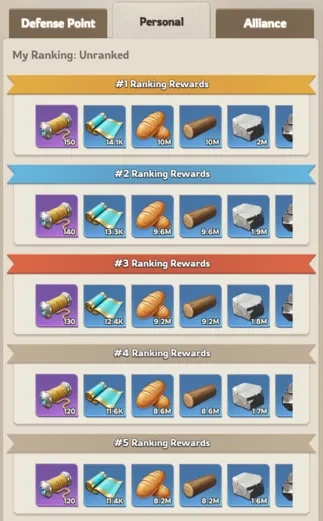
All combat in Viking Vengeance follows expedition mode rules. Rewards received are based on individual point milestones, individual ranking in your Empire, and your Alliances combined score ranking in your Empire. In new Empires, the rewards will be Alliance Tokens, Satin, Gilded Threads, and tons of resources. Eventually, Artisan’s Visions get added to the loot pool as your Lordrush Empire grows in age.
The Phases of Attack
- Waves 1-9 and 11-19: Vikings target individual player cities. Every alliance members’ towns will be attacked (although some will be skipped on certain waves; read below for more details).
- Waves 10 and 20: The Vikings pivot their focus to the Alliance Headquarters (HQ). These are massive rallies that require the entire alliance to coordinate a joint defense at the headquarters.
The Point System: Own Defense and Reinforcement
Understanding the split in point acquisition is a major factor for success. There are two ways to earn points:
- Personal Town Defense: You receive a set number of points for every wave your city survives. Crucially, you get these points regardless of whether you have one million troops at home or zero. The only way you will not get points is if your town does not fully defeat the invading Vikings. If your town loses combat to the Vikings twice, you will stop receiving additional Viking waves to your town during the invasion.
- Reinforcement Points: You earn points based on the number of Viking troops you defeat while your troops are stationed in another player’s city or the Alliance HQ. Importantly, you are not taking these points from the player you are defending. These potential points are awarded from a separate point pool than the Personal Town Defense points.
If we put these two things together, the beginnings of the basic strategy start to become apparent. Every troop left at your own Town means fewer points you earn from reinforcing others while simultaneously reducing the amount of points players reinforcing your Town get credit for. This means both you and your alliance miss out.
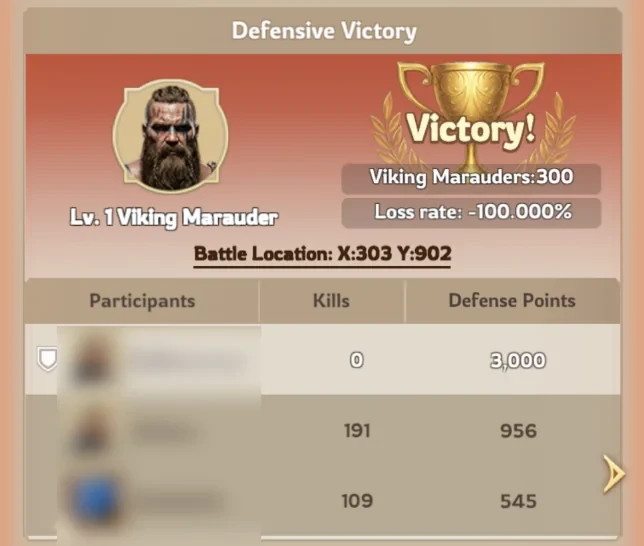
So theoretically, if every player kept all of their troops at home and never reinforced anyone else, the entire alliance would miss out on half of the available points in the event. So make sure they read this guide so you all understand how to not sabotage each other’s scores! To double your alliance’s total score, everyone must empty their towns and reinforce each other.
2. Viking Vengeance Combat Science: Adapting the Usual Rules to the Event
Lordrush expedition mode combat typically resolves in a specific way. A full combat guide is beyond the scope of this article, but the relevant points to understand are:
- Infantry, Lancers, and Archers choose their targets before damage is dealt (this is when the Lancer Ambusher skill is rolled)
- Attacks are launched by all troop types simultaneously and damage is calculated including troop defeats
- Defeated troops are cleared from combat from both sides simultaneously, but “credit” for defeating troops is resolved sequentially, first to infantry, then lancers, then archers. In other words.
That last line is extremely important for determining points in Viking Vengeance because points are awarded based on which troops get credit for defeating the Vikings. If more damage is dealt than needed, the credit is not awarded proportionally between troop types. So this can create situations where only the infantry actually gets credit (and thus points) in situations where you significantly outlevel the Viking Vengeance content. This can be true at lower difficulty settings or in earlier rounds of even harder difficulties.
This means in a situation in which you don’t have enough marches or march capacity to send out all of your troops, you should prioritize sending out infantry first (followed by lancers) since these are the most likely troops to steal points from players reinforcing you. Conversely, they are the most likely troops to get “first points” from Towns you are reinforcing.
Finally, there is another difference between Vikings Vengeance combat and regular expedition mode combat. Typically, expedition mode runs until all troops on one side are defeated. However, Viking Vengeance does not do this. It is possible to win an invasion wave but not have defeated all the Vikings fast enough.
In practice, this can create some edge cases where an all-infantry garrison that is not strong enough may leave some points on the table. In this case, some small share of lancers in the garrison may help increase the score through the use of their Ambush skill to target enemy archers in the same round that infantry target infantry. Generally this edge case is not impactful enough to change the overall strategy, but it may be something you encounter in the HQ defense waves.
3. How to Reinforce Players without Angering Your Alliance (and R4/5 Leadership)
When reinforcing players, you want to consider what the final rally formation will look like and your role in it. This is especially important in the early days of your Empire before players have overpowered this event and require good hero formation decisions to survive.
On defensive rallies, the rally leader isn’t always the garrison captain (of the Alliance HQ) or the owner of the Town being reinforced. The rally leader is actually the player with the most battle power in the rally, as per the in-game rules stated in battle reports.
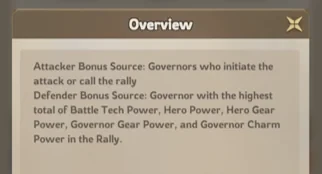
This means you might need to think differently about the heroes you send to reinforce a player if you are stronger versus weaker than other players in your alliance. If you are on the lower end of your alliance’s strength spectrum, then you will likely be a rally joiner. In that case, you would want to send rallies that have a strong joiner hero ability, that is the 1st expedition ability of the leftmost hero in your formation.
This is similar to the way Bear Hunt works when joining rallies, where certain heroes perform best. Unlike in Bear Hunt, however, defensive abilities do help to win battles, so Flint, for example would be an acceptable joiner hero.
However, my preference for reinforcing other players is to send offensive heroes like Rita, Miko, and Hyeri since they boost the attack of the garrison. This is important because the battles do not run until one side if fully defeated, and they can time out before you defeat the Vikings (and thus miss out on points). It also makes it more likely that infantry troops will clear all the Vikings, which can be helpful if players have too many troops to fit in all of their marches and want to avoid stealing points from other players.
As you get later in the game, you will eventually overpower these battles to the point where hero selection becomes less meaningful. Early on, it makes a big difference. So if you were going to send out a rally reinforcement, this formation would be perfectly acceptable due to Rita’s ability:
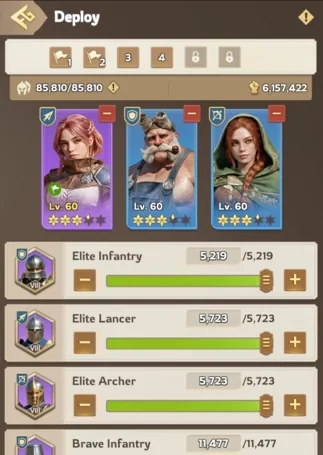
If you are a whale, however, then there is a good chance that you will be the rally leader in whatever town you reinforce. Thus sending a formation like the above has the potential risk that you bump out other players’ combat heroes for non-combat Blue heroes. This could weaken the resulting rally due to the lack of combat abilities, even though your other stats might be higher.
So if you are in this position, you want to make sure you have combat heroes in the 2nd and 3rd slot, just in case, while still maintaining a good rally joiner in the 1st slot. So a formation like the following would be good for any scenario:
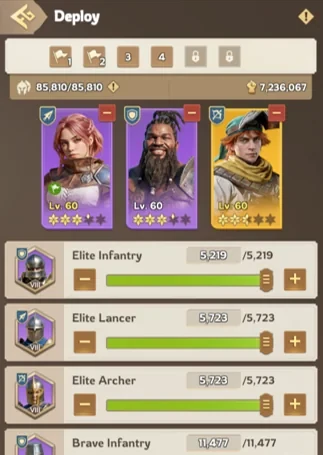
In both example formations shown, you would want to continue to increase the proportion of infantry troops in the formation as you train them. However, as long as you use safe hero formations like this, you will help your allies defeat tougher Viking waves and stop getting kicked out of your Alliance Headquarters.
4. Debunking the 7 Biggest Alliance Myths that Sabotage Your Score
Myth 1: "I must keep troops at home to save my city."
The Reality: This is the most common mistake new Lordrush players make and the biggest way to ruin everyone’s score. Since the alliance must clear each new difficulty level before it unlocks, you have a lot of time to build up to Difficulty 11 (about 3 months in real life). And even then, a city reinforced with 200,000 to 300,000 Tier 8 or Tier 9 troops can easily survive all 20 rounds, which should be extremely viable after playing the game that long. Sending your troops away to help a teammate ensures that both you and your alliance members maximize the reward. Only leave troops at home if you have more soldiers than your march slots can hold.
Myth 2: "I should heal my troops between rounds to stay strong."
The Reality: Tapping the healing indicator mid-event is a "score killer." Healed troops spawn inside your own city. Since you will likely have full marches out, you will not have an opportunity to send out these newly-healed troops. Therefore, they will simply stay at home and steal points from your Alliance members… and probably anger them in the process! If you absolutely must heal, wait until the interval between Wave 9 and Wave 10 (Alliance HQ wave), so you have time to reshuffle your marches to include them.
Otherwise, just let them wait to be healed for after the Vikings Vengeance event ends.
Myth 3: "I should send my best heroes to reinforce others."
The Reality: In Viking Vengeance, you may still be the Rally Captain of your own town, even if your troops are absent. This means that every teammate reinforcing you will use your hero levels, gear bonuses, and expedition skills to determine how powerful their reinforcing marches are. (There are some exceptions to this if you get reinforced by a stronger player who might become the rally leader.)
- The Play: Always keep your strongest combat/defense heroes (especially those with defensive widgets) at home. If you need help selecting them, then check out our Garrison Hero Tier List.
- The Reason: This acts as an "insurance policy" to ensure your reinforcers are as lethal as possible, protecting your city while maximizing everyone’s points.
Myth 4: "We need to camp in the Alliance HQ the entire time."
The Reality: The HQ is only under fire during Waves 10 and 20. Keeping troops there during the other 18 waves is a massive waste of potential points. It’s still better than keeping them at your own Town because you are at least not stealing your Alliance members’ points. However, you should be shuffling those troops between player towns to maximize Viking defeats and only moving to the HQ in the minutes leading up to the 10th and 20th waves.
Myth 5: "I can set my reinforcements and then go offline."
The Reality: The game heavily penalizes inactive governors. Vikings will not attack the towns of players who are offline during the critical "online-only" rounds: Waves 7, 14, and 17.
- If you are offline during these waves, your town gets zero survival points.
- Your teammates reinforcing your town get zero reinforcement points if you are offline.
Three rounds may not sound like a lot of points at risk. However, there is an aggressive scaling in the number of points at stake in these rounds. Roughly 1/3 of all Viking Vengeance points available comes from these 3 rounds. That makes being offline a severe penalty for anyone trying to get even a top 100 rank in their Lordrush Empire. So even if you cannot be “present” during the event, leaving your phone (or emulator!) on during the event time will increase everyone’s scores significantly.
It’s up to you to establish the right level of healthy limits on your gaming, and the purpose of this guide is not to push you to disregard it. Instead, the goal is to inform you about the tradeoff of missing this particular event so you can make the best choice for yourself.
Myth 6: "Park your troops once and never move them."
The Reality: In Viking Vengeance, successful governors are active governors. You must monitor your battle reports constantly.
- Is the player you are reinforcing offline? Check in your Alliance menu or see if they were attacked in Wave 7 (basically if you have a battle report for them or not). If so, move your troops immediately to online players.
- Is there a "Point Vacuum" in the town? (A much stronger player whose infantry is taking almost all of the points). If so, move your troops to a town that needs more coverage to ensure points are distributed more equitably across the alliance.
Please note, these are directional suggestions. For example, it is possible that an under-reinforced player who is offline may still yield you more troops than an online player. Eventually you will get a feel for this after enough repetitions of Vikings Vengeance. In any case, the point is to monitor and react accordingly when needed.
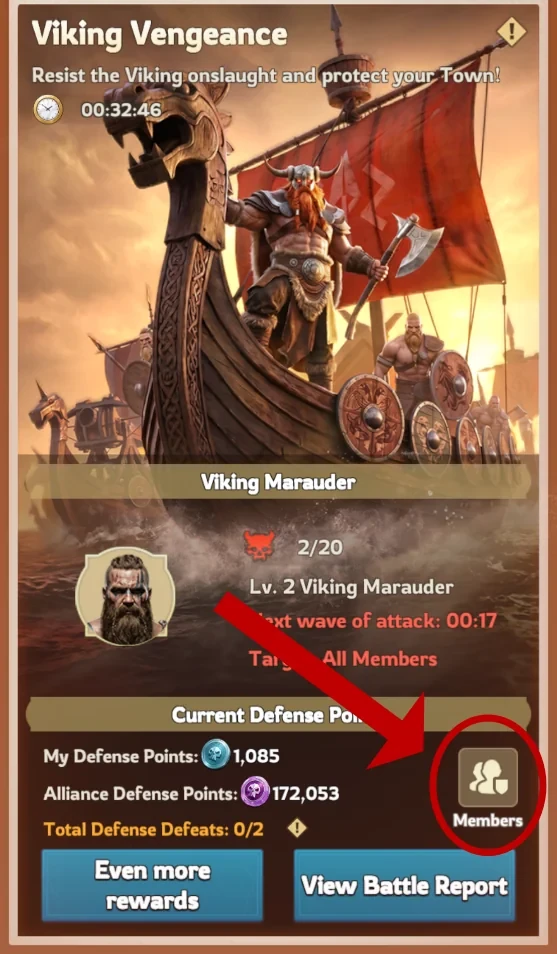
Be sure to use the menu in the Viking Vengeance UI to get a quick view of who is online and everyone’s current reinforcement numbers to make better decisions quickly.
Myth 7: "We should choose a lower difficulty to ensure we finish 20 waves."
The Reality: Always choose the highest difficulty available (Difficulty 11 at time of release). The point scaling for higher difficulties is significant. Completing only 17 or 18 waves on Difficulty 11 will almost always yield significantly more Satin and Gilded Threads than a perfect 20-wave clear on a "safe" lower difficulty.
There is also limited penalty for losing battles and the Vikings breaking through. You do not lose any resources, just take some minor damage to your Guard Station, which you can easily extinguish and repair. So always go for the highest difficulty level possible.
5. Advanced Alliance Coordination: The HQ Rules
Waves 10 and 20 are the flash points for alliance drama because the HQ has a strict governor limit and rally capacity. Alliance leadership must establish clear rules to prevent friction:
- The Merit-Based Approach: Only the top-stat players or otherwise pre-determined players are allowed into the HQ to give your best players the best chance to take top ranks in your Empire.
- The Equitable Approach: Set a strict troop limit (e.g., 50,000 troops per person) to allow more members (up to the governor limit) to fit into the garrison and share the massive point rewards from the HQ hits.
- Troop Composition for HQ: Alliances may choose to enforce pre-determines troop compositions for HQ reinforcement. This ensures that everyone in the HQ gets as close to equitable share of total points before the Vikings are wiped out. Otherwise, players may get more or less points from their composition based on how strong the overall garrison is (and thus how many of the total points available are soaked up by infantry).
These are potential suggestions that are commonly employed, but it is up to your alliance leadership which sort of rules (if any) they chose to enforce to fit your alliance’s culture.
6. Pro Tips for Individual and Alliance Success
- The "Offline Detection" Trick: Check the Alliance menu to see which players are online at the start of the event and adjust your troops accordingly before the online-only waves come out. Recall your troops and move them to an active player to save your score for Waves 7, 14 and 17.
- Leave Archers at Home (If Necessary): If you are a whale or longtime player with millions of troops and cannot send them all out, keep your archers at home. Since they are the last to be credited for defeating Vikings, they are the least likely to "steal" points and points from the teammates who are reinforcing you. If you can send out all troops, always choose to do so.
- Farm accounts: Having your own lower level farm account can also be an asset for improving your score in Vikings Vengeance. You can guarantee that the garrison will be clear and only defend it with your troops to get full points. The potential drawback is that your farm account will be offline (unless the character is tied to an account on a different device!), but even that might still have you come out ahead if you aren’t needing to share the points with other players.
Conclusion: Community over Individualism
Viking Vengeance is not a test of individual account power; it is a test of Alliance Coordination. By working together to empty towns, staying online for the critical Waves 7, 14, and 17, and prioritizing infantry for reinforcements, your alliance can dominate the Empire rankings.
Remember: the goal is for everyone to grow together. When your alliance members earn more Satin and Gilded Threads, the entire alliance becomes stronger for future content that helps support your growth further.